 ]]>]]>
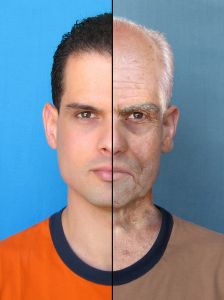 Can Humans Live to 1,000? Some Experts Claim We Can.
Cambridge University geneticist Aubrey de Grey has famously stated, “The first person to live to be 1,000 years old is certainly alive today …whether they realize it or not, barring accidents and suicide, most people now 40 years or younger can expect to live for centuries.”
Perhaps de Gray is way too optimistic, but plenty of others have joined the search for a virtual fountain of youth. In fact, a growing number of scientists, doctors, geneticists and nanotech experts—many with impeccable academic credentials—are insisting that there is no hard reason why ageing can’t be dramatically slowed or prevented altogether. Not only is it theoretically possible, they argue, but a scientifically achievable goal that can and should be reached in time to benefit those alive today.
“I am working on immortality,” says Michael Rose, a professor of evolutionary biology at the University of California, Irvine, who has achieved breakthrough results extending the lives of fruit flies. “Twenty years ago the idea of postponing aging, let alone reversing it, was weird and off-the-wall. Today there are good reasons for thinking it is fundamentally possible.”
Even the US government finds the field sufficiently promising to fund some of the research. Federal funding for “the biology of ageing”, excluding work on ageing-specific diseases like heart failure and cancer – has been running at about $2.4 billion a year, according to the National Institute of Ageing, part of the National Institutes of Health.
So far, the most intriguing results have been spawned by the genetics labs of bigger universities, where anti-ageing scientists have found ways to extend live spans of a range of organisms—including mammals. But genetic research is not the only field that may hold the key to eternity.
“There are many, many different components of ageing and we are chipping away at all of them,” said Robert Freitas at the Institute for Molecular Manufacturing, a non-profit, nanotech group in Palo Alto, California. “It will take time and, if you put it in terms of the big developments of modern technology, say the telephone, we are still about 10 years off from Alexander Graham Bell shouting to his assistant through that first device. Still, in the near future, say the next two to four decades, the disease of ageing will be cured.”
But not everyone thinks ageing can or should be cured. Some say that humans weren’t meant to live forever, regardless of whether or not we actually can.
“I just don’t think [immortality] is possible,” says Sherwin Nuland, a professor of surgery at the Yale School of Medicine. “Aubrey and the others who talk of greatly extending lifespan are oversimplifying the science and just don’t understand the magnitude of the task. His plan will not succeed. Were it to do so, it would undermine what it means to be human.”
It’s interesting that Nuland first says he doesn’t think it will work but then adds that if it does, it will undermine humanity. So, which is it? Is it impossible, or are the skeptics just hoping it is?
After all, we already have overpopulation, global warming, limited resources and other issues to deal with, so why compound the problem by adding immortality into the mix.
But anti-ageing enthusiasts argue that as our perspectives change and science and technology advance exponentially, new solutions will emerge. Space colonization, for example, along with dramatically improved resource management, could resolve the concerns associated with long life. They reason that if the Universe goes on seemingly forever—much of it presumably unused—why not populate it?
However, anti-ageing crusaders are coming up against an increasingly influential alliance of bioconservatives who want to restrict research seeking to “unnaturally” prolong life. Some of these individuals were influential in persuading President Bush in 2001 to restrict federal funding for embryonic stem cell research. They oppose the idea of life extension and anti-ageing research on ethical, moral and ecological grounds.
Leon Kass, the former head of Bush’s Council on Bioethics, insists that “the finitude of human life is a blessing for every human individual”. Bioethicist Daniel Callahan of the Garrison, New York-based Hastings Centre, agrees: “There is no known social good coming from the conquest of death.”
Maybe they’re right, but then why do we as humans strive so hard to prolong our lives in the first place? Maybe growing old, getting sick and dying is just a natural, inevitable part of the circle of life, and we may as well accept it.
“But it’s not inevitable, that’s the point,” de Grey says. “At the moment, we’re stuck with this awful fatalism that we’re all going to get old and sick and die painful deaths. There are a 100,000 people dying each day from age-related diseases. We can stop this carnage. It’s simply a matter of deciding that’s what we should be doing.”
One wonders what Methuselah would say about all this.
]]> Kids become chatterboxes within months of barely being able to speak a few words. How come?
Children do not need any specialised learning to suddenly improve their vocabularies. Instead, their behaviour can be described by a simple mathematical rule of thumb.
Parents become familiar with the so-called “word spurt”, the slightly disconcerting stage of a child’s life when they go from hardly talking to suddenly uttering hundreds of new words, sometimes after hearing them only once. (This can be disconcerting for parents whose children are suddenly uttering profanities like a angry truck-driver.)
At 18 months the average child can say 50 words, but by age two, they have learned up to 350 words; half a year later their vocabulary has doubled to 600.
Scientists have proposed various theories to explain children’s language land-grab. Perhaps learning a few basic words helps a child learn others. The theory of “naming insight”, for instance, suggests that at around 18 months children suddenly realise that each object has a specific name. (It’s not until around two that a child learns that when they cover their eyes and ‘hide’, that you can still see them.)
Another theory, called “fast mapping”, suggests that children quickly understand that groups of objects are related, and therefore they learn unfamiliar words describing objects within familiar groups more quickly.
Characteristic curve
Of course, there may be a much simpler explanation. The acceleration in a child’s learning may inevitably happen due to the way most languages are structured.
All languages contain a characteristic distribution and pattern of words. Where most are of medium difficultly to learn, there are a few that are either very easy, or very difficult. Children always learn a number of words in parallel. These parameters have been factored into computational models which simulate how long it takes to learn 10,000 new words.
Guess what? The simulation the model produces the same characteristic acceleration in learning. Essentially learning one new word makes learning another new word even easier. This allows a child to move through words of medium difficulty more quickly since their learned in parallel. Acceleration is an unavoidable by-product of variation in difficulty. (It’s a network effect.)
Of course computer modeling isn’t the real world and may not accurately get to the heart of while kids learn language so amazingly fast, but adults don’t learn as quickly and don’t show a similar acceleration in their language learning.
]]>Every year early 90 per cent of male spotted hyenas (Crocuta crocuta) leave their birth clan and disperse to pastures new, but until now it has never been clear what drives them away. Are they are avoiding competition for mates, trying to preserve resources for the rest of the pack, or avoiding inbreeding?
None of the above, say researchers led by Oliver Höner of the Leibniz Institute for Zoo and Wildlife Research in Berlin, Germany, who have been monitoring all 400 hyenas in the Ngorongoro crater, Tanzania, since 1996. They have shown that the females are running the show, driving males to leave by selectively mating with immigrants from outside the pack and leaving the ‘pack males’ to take increasingly cold showers.
“We found that female hyenas prefer to mate with males who have immigrated into their pack, or who were born into the clan after the female was born,” says Höner. By following this simple rule, females avoid inbreeding and help to maintain the genetic health of the pack.
None of the males could be reached for comment.
]]>There are 6 simple machines: Inclined Plane, Wedge, Screw, Lever, Wheel and Axle, and Pulley.
| A machine is a tool used to make work easier. Simple machines are simple tools used to make work easier. Compound machines have two or more simple machines working together to make work easier. In science, work is defined as a force acting on an object to move it across a distance. Pushing, pulling, and lifting are common forms of work. Furniture movers do work when they move boxes. Gardeners do work when they pull weeds. Children do work when they go up and down on a see-saw. Machines make their work easier. The furniture movers use a ramp to slide boxes into a truck. The gardeners use a hand shovel to help break through the weeds. The children use a see-saw to go up and down. The ramp, the shovel, and the see-saw are simple machines. | |
 | Inclined Plane A plane is a flat surface. For example, a smooth board is a plane. Now, if the plane is lying flat on the ground, it isn’t likely to help you do work. However, when that plane is inclined, or slanted, it can help you move objects across distances. And, that’s work! A common inclined plane is a ramp. Lifting a heavy box onto a loading dock is much easier if you slide the box up a ramp—a simple machine. Want to know more? Here’s extra information. |
 | Wedge Instead of using the smooth side of the inclined plane, you can also use the pointed edges to do other kinds of work. For example, you can use the edge to push things apart. Then, the inclined plane is a wedge. So, a wedge is actually a kind of inclined plane. An axeblade is a wedge. Think of the edge of the blade. It’s the edge of a smooth slanted surface. That’s a wedge! Want to know more? Here’s extra information. |
 | Screw Now, take an inclined plane and wrap it around a cylinder. Its sharp edge becomes another simple tool: the screw. Put a metal screw beside a ramp and it’s kind of hard to see the similarities, but the screw is actually just another kind of inclined plane. Try this demonstration to help you visualize. How does the screw help you do work? Every turn of a metal screw helps you move a piece of metal through a wooden space. And, that’s how we build things! Want to know more? Here’s extra information |
 | Lever Try pulling a really stubborn weed out of the ground. You know, a deep, persistent weed that seems to have taken over your flowerbed. Using just your bare hands, it might be difficult or even painful. With a tool, like a hand shovel, however, you should win the battle. Any tool that pries something loose is a lever. A lever is an arm that “pivots” (or turns) against a “fulcrum” (or point). Think of the claw end of a hammer that you use to pry nails loose. It’s a lever. It’s a curved arm that rests against a point on a surface. As you rotate the curved arm, it pries the nail loose from the surface. And that’s hard work! |
 | Wheel and Axle The rotation of the lever against a point pries objects loose. That rotation motion can also do other kinds of work. Another kind of lever, the wheel and axle, moves objects across distances. The wheel, the round end, turns the axle, the cylindrical post, causing movement. On a wagon, for example, the bucket rests on top of the axle. As the wheel rotates the axle, the wagon moves. Now, place your pet dog in the bucket, and you can easily move him around the yard. On a truck, for example, the cargo hold rests on top of several axles. As the wheels rotate the axles, the truck moves. |
 | Pulley Instead of an axle, the wheel could also rotate a rope or cord. This variation of the wheel and axle is the pulley. In a pulley, a cord wraps around a wheel. As the wheel rotates, the cord moves in either direction. Now, attach a hook to the cord, and you can use the wheel’s rotation to raise and lower objects. On a flagpole, for example, a rope is attached to a pulley. On the rope, there are usually two hooks. The cord rotates around the pulley and lowers the hooks where you can attach the flag. Then, rotate the cord and the flag raises high on the pole. |
| If two or more simple machines work together as one, they form a compound machine. Most of the machines we use today are compound machines, created by combining several simple machines. Can you think of creative ways to combine simple machines to make work easier? Think about it. | |
]]>
 Everyone seems to know the basics, hair is made of dead cells. Beyond that we only know to shampoo it, comb it and try to prevent split ends. So how exactly is this hair formed when we have plenty of other dead cells falling off our skin all the time?
The key is a substance called keratin. When the cells die it leaves a cylinder of keratin, an extremely strong protein. So strong in fact, that the only biological material stronger than keratin is chitin. Now before you go bragging about how strong your keratin is to all those bald friends you need to know that their are types of keratin. It just happens to be that the keratin that makes up the hair on your head is not near as tough as that which makes up the claws and scales of reptiles.
So yes, their keratins could beat up your keratins.
While completely lifeless, hair does contain minerals, fats, and water (10%). So, if you are ever on a deserted island you could survive just a little longer on a nice fistful of hair. However, growing on average 1 cm a month means this food supply isn’t very replenishable. Eat wisely.
 Puppy Love isn’t just just the glassy-eyed look that teen girls get when watching Johnny Depp in Pirates of the Caribbean. Nope, it’s an actual condition in which teens show a number of manic and risky behaviors.
It seems that there is some scientific evidence to show that adolescents who feel ‘madly in love’ may be right. They actually are ‘mad’.
Lovestruck teens show many of the symptoms of a condition called ‘hypomania’ (a less pronounced form of regular mania) in which they sleep about an hour less that teens who aren’t smitten. They also act more compulsively, spend more money, drive faster, and pass more notes in class. (The note’s also have 500% more hearts and balloon writing on them than normal class notes.)
One study demonstrated that youngins in early-stage intense romantic love acted exactly as psychiatric patients during a hypomanic stage, concluding that intense romantic love in teenagers is a “psychopathologically prominent stage”.
Oddly enough, the symptoms of hypomania overlap with those of regular mania. These symptoms are visible in teens as periods of depression, endless texting to friends, ‘Do not enter’ signs appearing on their bedroom doors, an inability to be ‘understood by anyone, and a pronounced decrease in how cool they think their parents are. Don’t worry, there’s nothing you can do about this. (You may still want to hide the car keys and affix a geo-locator to your teen.)
Ah, the wonder of those teenage years. Hair sprouting everywhere and mania to boot.
 Where would we be without dirt?
 Dirt (soil) forms the pedospherem, which is a nice Latin name for the grubby interface between the lithosphere (rocky part of the planet) and the biosphere, atmosphere, and hydrosphere.
Dirt is a three phase system comprised of all kinds of little bits, from rocks and minerals, organic matter (including all sorts of living organisms), ice, weathered rock and precipitates, liquid water solutions, and gases (worm farts).
The ‘liquid phase’ is primarily water, and is also known as the ‘soil solution’ where plants get their nutrients. The ‘gaseous phase’ is important for supplying oxygen to plant roots for respiration. Fortunately, there is no ‘teenager phase’.
Soil formation, or pedogenesis, (use that in a sentence some time this week) is the combined effect of physical, chemical, biological, and anthropogenic processes on big things turning them into progressively littler things which you want to keep out of the corners of your bathroom.
Oh yeah, we’re all going to become dirt in the end so show some respect.
]]>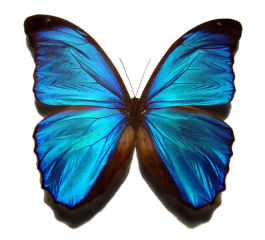 Can a butterfly flapping it’s wings can cause a hurricane?
A more technical description would be: sensitive dependence on initial conditions in chaos theory where small variations of the initial condition of a nonlinear dynamical system produce increasingly large variations in the long term behavior of the system. Whew.
The phrase The Butterfly Effect refers to the idea that the single flap of a butterfly’s wings change the initial conditions of the system enough to cause large-scale phenomena (hurricanes and such) since any variation in the initial conditions is vastly magnified with each iteration. And every flap of every butterfly wing in the world continually changes those conditions. (Someone passing gas in France probably caused the Katrina hurricane.) Now you know why you don’t want to be a weatherman. It basically means that we’ll never be able to predict the weather for more than a few days.

See that equation? Looks tricky doesn’t it? You can’t understand how my wife drives either.
Comparing the butterfly effect to the domino effect is slightly misleading. In the domino effect there is dependence on the initial sensitivity, but whereas a simple linear row of dominoes would cause one event to initiate another similar one, the butterfly effect amplifies the condition upon each iteration. Also, dominos are a game played by old people in Miami.
Animal populations can be subject to the same phenomena.
Predator-prey systems have complex dynamics. A bio system with two variables such as rabbits and foxes can create a system that is much more complex than is readily apparent. Lack of foxes means that the rabbit population can increase, but increasing numbers of rabbits means foxes have more food and are likely to survive and reproduce, which in turn decreases the number of rabbits.
So please, don’t pass gas. Forecasting the weather is hard enough.
 Evolution is a fact. How evolution works is a theory.
“In the American vernacular, ‘theory’ often means ‘imperfect fact’—part of a hierarchy of confidence running downhill from fact to theory to hypothesis to guess. Thus the power of the argument: evolution is ‘only’ a theory and intense debate now rages about many aspects of the theory.
If evolution is less than fact and scientists can’t even make up their minds about the theory, then what confidence can we have in it?
Well evolution is a theory. It is also a fact. And facts and theories are different things, not rungs in a hierarchy of increasing certainty. Facts are the world’s data. Theories are structures of ideas that explain and interpret facts. Facts don’t go away when scientists debate rival theories to explain them. Einstein’s theory of gravitation replaced Newton’s in this century, but apples didn’t suspend themselves in midair, pending the outcome.”
- Stephen J. Gould, ” Evolution as Fact and Theory”; Discover, May 1981
Let’s consider evolution in light of another scientific fact - gravity. Gravity is also fact. How gravity works is a theory. Current theories about gravity might be disproved, but gravity itself remains a fact.
A number of terms have been attached to Darwin’s theory although they are commonly misunderstood.
Survival of the fittest does not mean survival of the strongest, smartest, fastest or best camouflaged. Survival of the fittest means that an organism that is best adapted to its ecological niche is more likely to create more offspring than less fit individuals. Consider the garden slug as an great example of fitness for survival.
Natural selection is Darwin’s theory of how the environment works on species. Individuals that are most successfully reproducing viable offspring form the core gene pool of a species. Environmental forces determine which individuals survive.
The evidence for Darwin’s theory of evolution grows more unimpeachable as science discovers more about chemistry, geology, and biology.
Take a look at your dog. He’s a perfect display of the mechanisms of evolution. If he’s anything other than a 30 pound dingo looking mutt, the gene’s he displays that make him a cock-a-poo, German Shepard, or Bouvier (my favorite) were selected from an existing gene pool by humans to make him what he is. While all dogs are the same species and a great dane can breed (theoretically) with a chiwawah, you get the idea. His genes have been modified over time to make him different than he was.
So, The Theory of Evolution does not describe evolution as a supposition. It is the the current thinking about how the fact of evolution manifests itself.
